Waterfall vs Agile Development for U.S. Corporations
Executive Summary: The Strategic Choice
For an organization like GlobalGeographic Inc., operating at the intersection of technology, data, and rapid market change, the choice of development methodology is not merely a technical decision—it is a strategic business imperative. Having guided numerous U.S. corporations through this exact evaluation, I can affirm that the decision between Waterfall and Agile hinges on one core question: Is your primary need predictability or adaptability?
This analysis will demonstrate that while Waterfall offers the comfort of a fixed plan, the Agile methodology provides the resilience, speed, and customer-centricity required to thrive in today’s dynamic landscape. The data is compelling: organizations using Agile report a 75.4% project success rate and are better positioned to respond to unforeseen challenges . This document will provide a comparative framework, evidence-based insights, and a actionable roadmap to guide GlobalGeographic Inc. toward a more agile, responsive, and value-driven future.
Part 1: Core Methodologies Deconstructed
The Waterfall Model: A Linear Journey with Defined Checkpoints
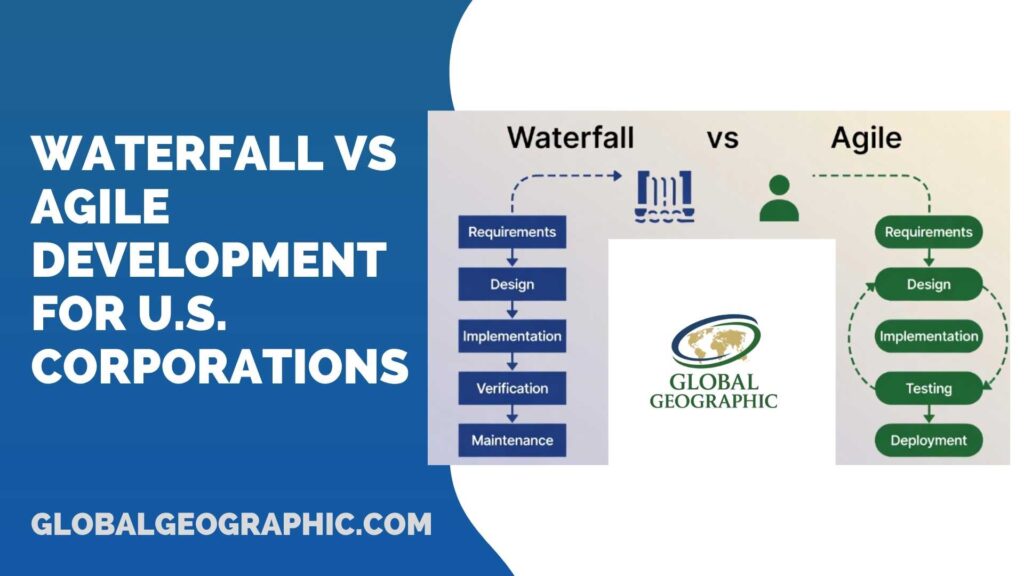
Think of Waterfall as a sequential relay race. Each phase—Requirements, Design, Implementation, Testing, Deployment, Maintenance—must be fully completed and documented before the baton is passed to the next . The entire project scope, timeline, and cost are defined at the outset, creating a predictable, well-structured plan.
- Ideal Use Case for Waterfall:
- Projects with fixed, unambiguous requirements and a clear, unchanging vision of the final deliverable.
- Heavily regulated industries where comprehensive, upfront documentation is mandatory for compliance and audit trails.
- Physical product development (e.g., hardware components) where later-stage changes are prohibitively expensive or impossible .
- Inherent Limitations:
- Inflexibility to Change: Incorporating new feedback or adapting to market shifts once development has begun is exceptionally difficult and costly .
- Late Risk Discovery: Testing occurs only after the complete product is built, meaning critical flaws may be discovered months or years after the project began .
- Value Delivery Delay: The business and customer realize no value until the very end of the project lifecycle .
The Agile Framework: An Iterative Cycle of Learning and Delivery
Agile, in contrast, is an iterative cycle of building, measuring, and learning. Work is broken down into small, time-boxed iterations (called Sprints in the Scrum framework), typically lasting 1-4 weeks . Each iteration results in a working, potentially shippable increment of the product, allowing for continuous feedback and course correction .
- Core Strengths of Agile:
- Adaptability: It welcomes changing requirements, even late in development, turning market shifts into a competitive advantage .
- Early and Continuous Value Delivery: Stakeholders see working software frequently, enabling earlier realization of ROI and ensuring the project remains aligned with business needs .
- Reduced Risk: Continuous testing and feedback loops identify issues early, when they are less costly to fix .
- Practical Challenges:
- Less Predictable: The final product and its total cost can be less defined at the outset, which can be unsettling for traditional finance and planning departments .
- Demands High Collaboration: It requires constant, active involvement from business stakeholders, product owners, and cross-functional teams .
- Can Feel Undisciplined: Without a strong commitment to its principles, Agile can devolve into a chaotic series of reactive changes without strategic direction .
Part 2: A Comparative Analysis for Corporate Decision-Making
The following table synthesizes the fundamental differences between these two approaches across critical business dimensions.
| Dimension | Waterfall Approach | Agile Approach |
|---|---|---|
| Core Philosophy | Linear, sequential process; “do it right the first time” | Iterative, cyclical process; “inspect and adapt” |
| Project Planning | Comprehensive, upfront planning defines the entire project | Evolutionary planning; details are refined each iteration |
| Flexibility | Resistant to change; modifications are costly and disruptive | Embraces change; requirements evolve throughout the project |
| Testing Phase | A single, dedicated phase after implementation is complete | Continuous, integrated testing within every iteration |
| Documentation | Heavy emphasis on comprehensive documentation upfront | Prefers working software; documentation is lean and just-in-time |
| Customer Feedback | Primarily at the beginning (requirements) and end (delivery) | Frequent, built into the end of every iteration |
| Primary Measure of Success | Adherence to the planned scope, budget, and timeline | Delivery of working software that provides customer value |
Part 3: The Verdict – Why Agile is the Dominant Paradigm
The industry trends are unequivocal. As of 2025, approximately 86% of software development teams utilize Agile practices, and its adoption is growing rapidly in engineering, R&D, and even marketing . This shift is driven by tangible outcomes:
- Enhanced Project Success: Data reveals that 39% of organizations employing Agile report the highest average project performance, with an overall success rate of 75.4% .
- Superior Business Alignment: Nearly three in five Agile practitioners report higher satisfaction due to better alignment with business needs and enhanced team collaboration .
- Proven Resilience: Studies, including a joint investigation by McKinsey and Harvard Business School, found that business units that had fully embraced an agile model demonstrated greater resilience during the challenges of the COVID-19 pandemic .
For GlobalGeographic Inc., this means that adopting Agile is not about chasing a trend, but about building a institutional capability for resilience, innovation, and customer focus that is critical for long-term competitiveness.
Part 4: The Rise of the Hybrid Model and Modern Agile Evolution
For large corporations, the choice is rarely a binary one. The most pragmatic path is often a hybrid approach, which has seen a 57% increase in adoption from 2020 to 2023 .
- The Hybrid Model in Practice: This could involve using Waterfall for high-level, initial budget and portfolio planning, while empowering individual product teams to use Agile (Scrum or Kanban) for execution and delivery . This provides the financial governance the C-suite requires with the development speed and flexibility the market demands.
- The Evolution of Agile in 2025: The practice of Agile is itself evolving. Key trends your organization should be aware of include:
- A Return to Fundamentals: A movement away from rigid, scaled frameworks back to core Agile principles of customer value, technical excellence, and continuous improvement .
- Evolution of Roles: Pure “process” roles like Scrum Master are evolving into hybrid technical leadership positions that combine facilitation with technical mentorship .
- Business Agility: Agile is expanding beyond IT. We now see 28% of business operations and 20% of marketing teams adopting Agile principles, breaking down silos and creating a more responsive organization .
Part 5: A Strategic Roadmap for GlobalGeographic Inc.
Transitioning to an Agile mindset is a cultural transformation, not just a process change. Based on my experience, I recommend the following phased approach:
- Assessment and Education (Months 1-2):
- Conduct a candid evaluation of your current project portfolio. Identify a pilot project that has high visibility but manageable complexity.
- Invest in Agile training and coaching for the pilot team and its stakeholders to ensure a shared understanding of the new mindset and practices.
- Pilot Implementation (Months 3-6):
- Form a truly cross-functional team for the pilot project, granting them the autonomy to manage their work.
- Start with a well-established framework like Scrum or Kanban, and focus on mastering the basics: backlog refinement, daily stand-ups, sprint reviews, and retrospectives.
- Scale and Refine (Months 7-12+):
- Use the lessons and success metrics from the pilot to build a compelling case for wider adoption.
- Gradually expand Agile practices to other teams, adapting the framework to different contexts (e.g., marketing, operations) while preserving the core principles.
- Integrate Agile reporting into your executive dashboards, focusing on value-delivery metrics like cycle time and customer satisfaction over traditional vanity metrics.
Conclusion: Building an Adaptive Advantage
The question for GlobalGeographic Inc. is not simply “Waterfall or Agile?” but “How do we build an organization that can learn and adapt faster than the environment is changing?” While Waterfall may still serve specific, well-defined projects, the overarching strategic imperative is to cultivate agility across your operations.
The evidence is clear: Agile fosters a culture of collaboration, accelerates time-to-market, and mitigates risk by validating assumptions early and often. By embarking on this transformation, you are not just changing how you build software—you are future-proofing GlobalGeographic Inc. against an unpredictable world, ensuring that you can navigate new competitive landscapes and meet evolving customer demands with confidence and precision.
Sameer C is a business analyst and technology consultant with over 15 years of experience in translating complex business requirements into efficient, scalable technological solutions. He is deeply committed to helping organizations like GlobalGeographic Inc. navigate digital transformation with strategic clarity and operational excellence.